
Professor at the Ecole Polytechnique de Louvain and President of the iMMC – Institute of Mechanics, Materials and Civil Engineering at UCLouvain, Prof. Aude Simar has set up her own research team to develop new materials using innovative manufacturing processes, in particular 3D printing. Her work should lead to new aluminium alloys that are widely used in the aeronautics and aerospace industries.
The ALUFIX Project
It all began in 2016 when Prof. Simar was awarded a prestigious Starting Grant from the European Research Council (ERC) for the ALUFIX project. The aim of this project, which was completed in 2022, was to develop new aluminium-based self-healing materials and to mitigate damage to existing aluminium alloys. Aluminium is the third most abundant material on earth after oxygen and silicon. It is also widely used in the manufacturing of complex parts for the aeronautics and aerospace industries, as well as road transport (truck parts) and satellites. However, the manufacturing of aluminium, the result of the transformation of bauxite, is very energy-intensive, even if some of the aluminium produced is recycled.

Achieving Carbon Neutrality
According to the Waypoint 2050 study, achieving the 0-carbon objective will not only involve replacing fossil fuels: we also need to take action on industrial processes and invent new technologies. That’s why Prof. Simar’s team is closely studying Laser Powder Bed Fusion (LPBF), a technology that involves depositing a layer of powder and melting it with a laser in the required location — an interesting technology for the self-healing of high-strength materials that suffer from a large number of cracks and porosity. Here, the part healing acts as a repair process, avoiding the need to recycle the entire part produced. Just as the skin heals itself, this bio-inspired technology has been widely developed for polymer materials used in the automotive industry but is only in its infancy in what aluminium alloys are concerned.
Can Metals Be Healed?
This is where Prof. Simar’s team comes in. The aim is to apply LPBF technology to metals by coupling it with 3D printing technology for non-destructive visualisation of the material being studied. The principle is simple: a material is deliberately damaged and then its behaviour is studied at the ESRF synchrotron in Grenoble, France. After an initial observation phase, it is healed by a heat treatment that allows the low melting point part of the aluminium alloy to turn to liquid, keeping the part structural integrity. The cracks are then filled with just enough liquid to ‘seal the breach’.
Are These Alloys Strong Enough?
Prof Simar’s team is working on the development of another innovative technology: the production of high-strength, light alloys. An initial material, developed from aluminium and magnesium, was the subject of the ERC-ALUFIX project. The only problem was that it was not strong enough, with a yield strength of only 150 MPa. Within this framework, Prof. Simar’s team is involved in a number of research collaborations, starting with HAMAAC, an M-ERA-NET project that began in 2023 with European industrial and research partners in the Czech Republic. The aim of the project was twofold: to develop a high-strength self-healing aluminium alloy and to develop a procedure and tools for observing at a large extent of scales this new self-healing aluminium alloy using tomography (3D imaging). This made it possible to better characterise these new materials and facilitate their healing, down to a few micrometres.
The “Almazium” Alloy
In the framework of the HAMAAC project, a second alloy in which aluminium and magnesium are supplemented by zirconium was developed, called the Almazium ®. The result: increased strength equivalent to 400 MPa, with similar healing capabilities. What’s more, this alloy loses none of its mechanical properties when heated for healing. A patent was filed in February 2024. A new European M-ERA-NET project, called STITCHING, has been underway since 2026. The overall objective is to expand the (industrial) applicability of ALMAZIUM® by evaluating (i) its weldability and (ii) its printability using other wire-based additive manufacturing techniques, while monitoring the impact on its healing capabilities and strength. Partners from the Czech Republic (CEITEC, CaCtuX), France (ONERA, Institut Maupertuis, EMSE), and Belgium (AnyShape, BWI, EHP) are participating in this project.
Scaling Up and Recycling Chips
On the strength of these promising results, Prof. Simar has obtained funding from the WEL Research Institute for the RESSusCItAM project. Launched on 6 October 2023 for a period of 4 years, this project is based on 3D printing technology using friction. It aims to scale up the self-healing strategy, replacing the metal powder used in LPBF with a new feedstock. The LPBF process is limited to small parts (typically smaller than 500mm). Friction stir based additive manufacturing, by contrast, can build parts as large as any milling machine can handle. This process uses a high-speed rotating metal rod that is pressed against a substrate / or previous layer.
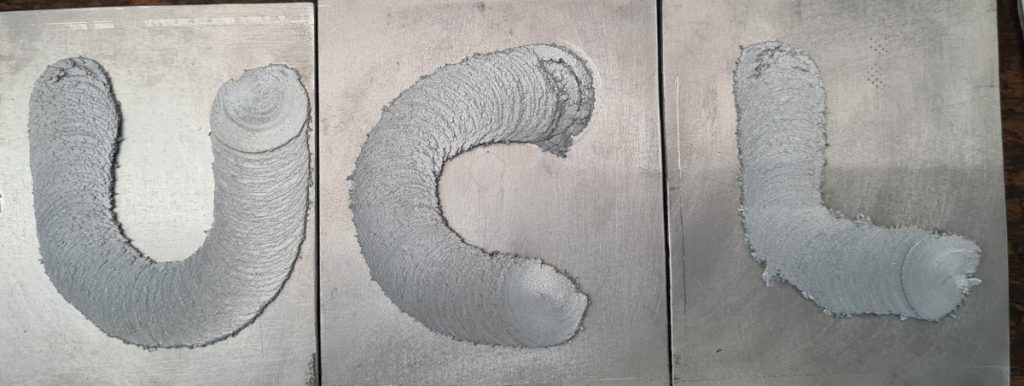
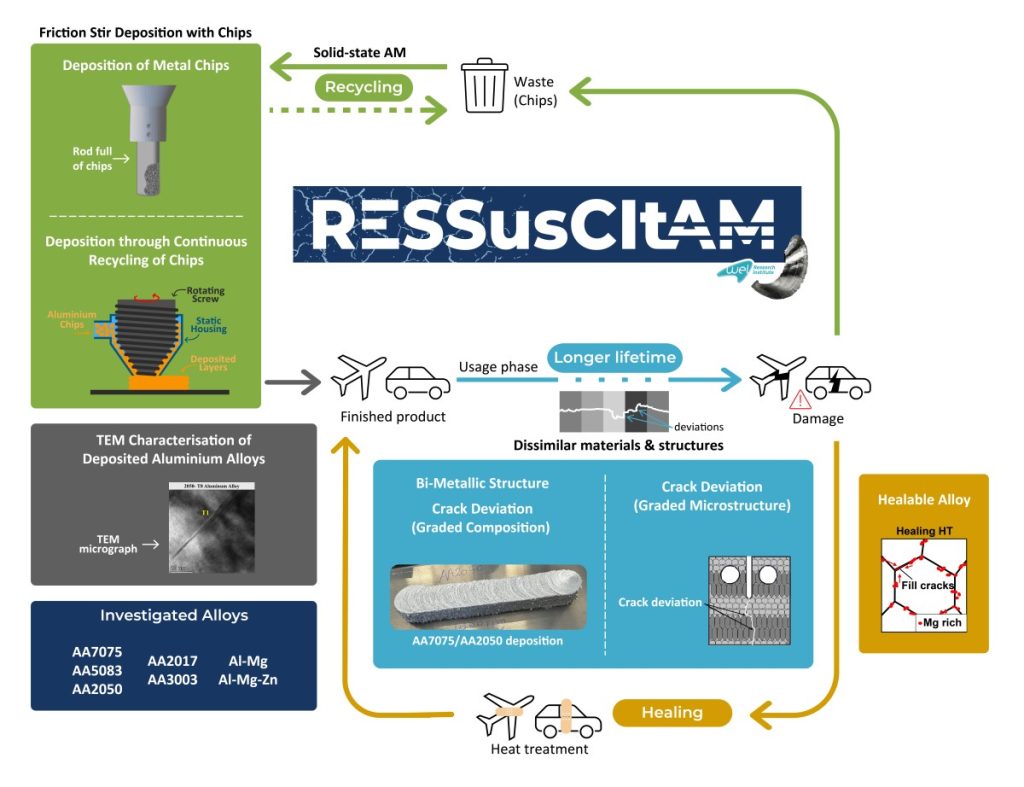
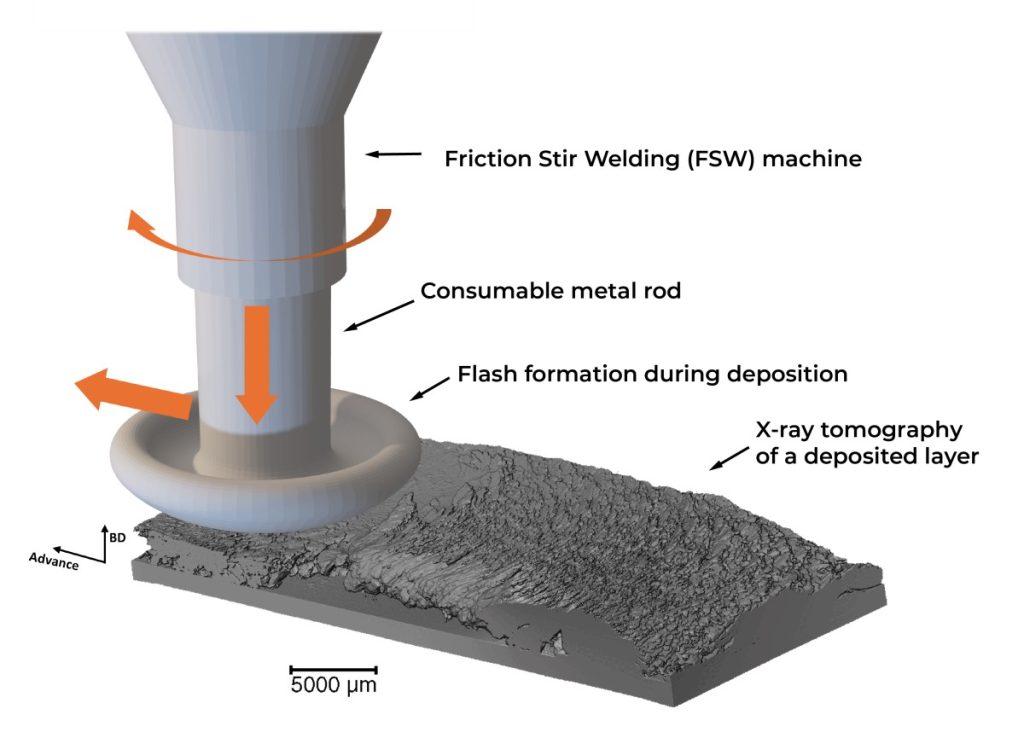
The friction generates heat that softens the material, which can then be deposited to build up the part. Beyond that, this friction-based process allows manufacturing new parts directly from metal chips, a solid-state recycling pathway that avoids the energy-intensive melting step. Solid-state recycling also sidesteps the drawbacks of conventional melting-based recycling routes: the formation of floating particles or “dross” (a source of 20% material loss), and the degradation of mechanical properties caused by zinc and magnesium evaporation. Thanks to this technique, it is also possible to create graded microstructures and compositions to enhance part lifespan. Parts that are both healable and made from recycled chips, while lasting longer, would represent a real step forward for circular, bio-inspired manufacturing that is more respectful of the environment.

iMMC – Institute of Mechanics, Materials and
Civil Engineering
Place Sainte Barbe 2 – B-1348 Louvain-la-Neuve
Tel.: +32 (0)488 56 03 05
Email: aude.simar@uclouvain.be
