
Interview with Prof. Vincent VAN PESCH
Chief of the Neurology Department, Cliniques universitaires Saint-Luc, Brussels
Professor, UCLouvain
Principal Investigator, Neuroimmunology and CSF Neurochemistry Unit, Institute of Neuroscience, UCLouvain
What is the prevalence of multiple sclerosis in Belgium in 2026, and what do we know about the causes of this pathology?
Multiple sclerosis (MS) remains one of the most frequent chronic inflammatory neurological diseases of young adults, although it is increasingly also a disease of midlife and later life because people with MS now live longer and are treated earlier. A recent Belgian national burden-of-disease assessment estimated a prevalence of 0.19%, suggesting that at least 12,000 to 14,000 people live with MS in Belgium. However, a more complete national registry data may revise this estimate upward.
MS is a multifactorial disease. Genetic susceptibility is important, but it is not sufficient to explain the disease. The environmental component has become much clearer over the last decade. Epstein-Barr virus infection is now considered one of the strongest risk factors; low sunlight exposure and vitamin D deficiency, smoking, adolescent obesity, and probably other environmental and lifestyle exposures also contribute. These factors do not act in isolation. They interact with the immune system, the central nervous system, sex, age, and genetic background over many years before the first neurological symptoms appear. This long preclinical phase is one reason why prevention, early recognition, and more precise biomarkers have become so important in MS research.
How has the management of MS changed between 2020 and 2026?
The major shift has been from a reactive strategy to a proactive one. We no longer wait for repeated clinical relapses before considering high-efficacy therapy. In many patients, particularly younger patients with active disease or poor prognostic features, early high-efficacy treatment is standard of care. The therapeutic landscape has become more diverse, with anti-CD20 therapies, natalizumab, S1P receptor modulators, cladribine, fumarates, teriflunomide, interferons, glatiramer acetate, and several real-world strategies for switching, escalation, de-escalation, pregnancy planning, and vaccination.
Diagnosis has also evolved. The 2024 revision of the McDonald criteria, published in 2025, provide a unified framework for pre-symptomatic, relapsing and progressive presentations. This is highly relevant for clinical practice because earlier diagnosis must be balanced with safeguards against misdiagnosis.
Finally, follow-up has become more quantitative. MRI remains central, but serum and CSF biomarkers such as neurofilament light chain, kappa free light chains are progressively used in the clinic. The COVID-19 period also forced us to better integrate infection risk, vaccine responses, treatment timing, and shared decision-making into the care of people living with MS.
Could you present your clinical and research work on multiple sclerosis?
My work is built around the integration of clinical care, clinical trials, neurochemistry, and translational immunology. At Cliniques universitaires Saint-Luc, I coordinate a multidisciplinary MS and neuroimmunology program that follows a large cohort of patients and integrates diagnostic work-up, treatment selection, monitoring, pregnancy and vaccination counselling, neuropsychological and imaging follow-up, and participation in research protocols. Since 2025 I serve as Chief of the Neurology Department.
At UCLouvain, I lead the Neuroimmunology and CSF Neurochemistry Unit within the Institute of Neuroscience. The laboratory focuses on the study of blood and cerebrospinal fluid biomarkers for MS, and immune dysregulation in MS.
Clinical research is another core component. Since 2014, I have been principal investigator or co-investigator in more than 60 phase I-IV studies in MS, including pivotal therapeutic trials, extension studies, real-world evidence registries, and investigator-initiated academic projects. This clinical-trial activity is important because it connects our patients with innovation while allowing us to evaluate long-term effectiveness, safety, treatment sequencing, and patient-centered outcomes beyond the highly selected populations of registration trials.
What have been the main research achievements during the 2020-2026 period?
The 2020-2026 period has been particularly productive because several research lines matured from exploratory biomarker discovery into mechanistic and translational programs.
Through the Action de Recherche Concertée program on extracellular vesicles in MS, developed with Prof. Anne des Rieux and Prof. Giulio Muccioli at the Louvain Drug Research Institute, we have strengthened a consortium combining neuroimmunology, pharmaceutical sciences, nanomedicine, and bioactive lipid biology. This program has studied extracellular-vesicle cargo as both biomarkers and potential actors in disease mechanisms, with particular attention to microRNAs, immune regulation, and oligodendrocyte biology. This collaborative work with Prof. Anne des Rieux opens perspectives for developing nanomedicines capable of reaching the central nervous system more efficiently than conventional approaches.
A second major achievement has been the development of a neuroimagery research group by Prof. Pietro Maggi (Louvain Neuroinflammation Imaging Lab at UCLouvain). This has led to collaborative publications bridging advanced MRI biomarkers (paramagnetic rim lesions, the central vein sign, cortical lesions, perivascular spaces and vascular comorbidity) with clinical and biological markers of neuroinflammation. Together, these studies moved our program toward an integrated model in which imaging markers of compartmentalized inflammation are analyzed alongside CSF and blood biomarkers, strengthening both diagnostic precision and prognostic stratification in MS.
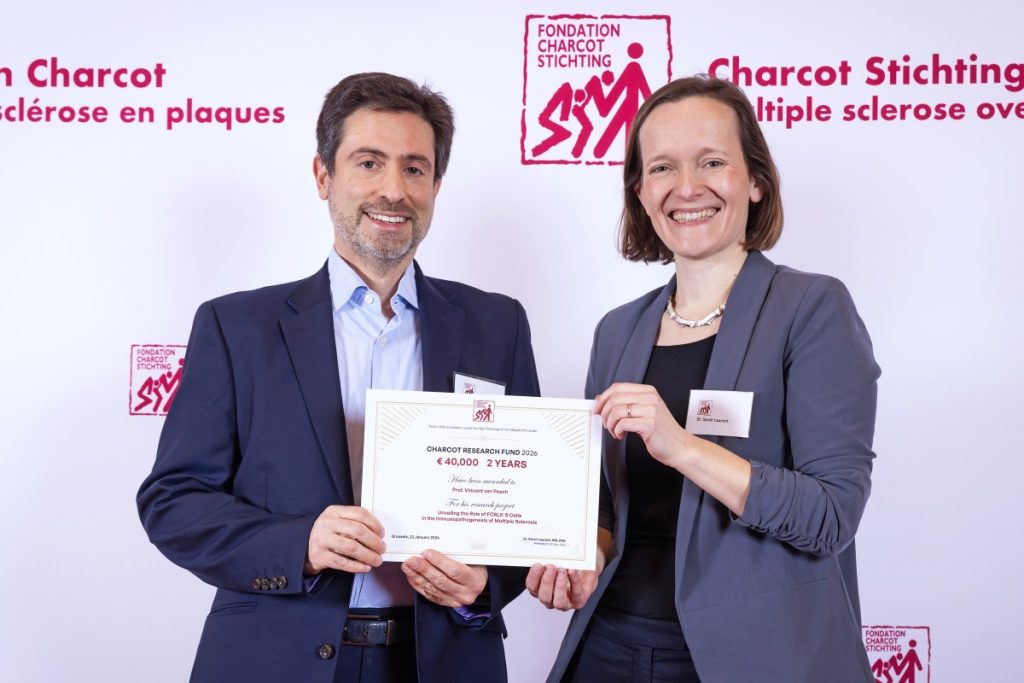
During the same period, we also opened a new line of research on atypical B cells. In our FCRL5 work (Deltombe, Stölting, Maggi and van Pesch, Neurology: Neuroimmunology & Neuroinflammation, 2025), we showed that soluble FCRL5 can be measured in the CSF and is increased in relapsing-remitting MS, with higher CSF levels associated with the risk of new brain lesions over 24 months. This links atypical memory B-cell biology to disease activity, biomarker development, and future therapeutic mechanisms.
What research projects are you currently working on in 2026?
Building on these results, we are now exploring immune-cell phenotypes, CSF-enriched signatures, and imaging-biology correlations that may be linked to Epstein-Barr virus, compartmentalized inflammation, treatment response, or future disease activity. The aim is not only to identify biomarkers, but to understand which immune populations are driving disease persistence and which are merely bystanders.
We also remain strongly involved in clinical trials for novel immunotherapies and real-world research. In 2026, the field is closely watching the emergence of brain-penetrant Bruton tyrosine kinase inhibitors, with positive phase III data reported, while their safety will need careful monitoring. These therapies are scientifically interesting because they may target both peripheral immune activation and innate immune mechanisms within the central nervous system. Whether they will change long-term progression remains one of the key questions.
In your opinion, what are the main challenges and future perspectives for MS?
The central challenge is no longer limited to preventing relapses. We have become much better at suppressing focal inflammatory activity, but many patients still experience progression independent of relapse activity (PIRA). This smouldering component of MS involves compartmentalized inflammation, microglial and astroglial activation, meningeal immune structures, chronic active lesions, axonal injury, mitochondrial stress, and insufficient repair. If we want to change the long-term prognosis of MS, we must better target these mechanisms directly.
The future of MS will therefore be built around five priorities. The first is prevention, including a better understanding of the Epstein-Barr virus-MS relationship, lifestyle risk factors, and possibly vaccination strategies. The second is earlier and more specific diagnosis, using MRI markers such as the central vein sign and paramagnetic rim lesions, CSF biomarkers such as kappa free light chains, and blood markers that can be repeated over time. The third is precision treatment: choosing the right therapy for the right patient at the right moment, while considering age, pregnancy, comorbidities, infection risk, vaccine responses, patient preferences, and long-term safety.
The fourth priority is to reach the central nervous system more effectively. This includes brain-penetrant small molecules, optimized antibody delivery, nanomedicines, and possibly cellular approaches in selected severe autoimmune diseases. The fifth priority is repair: remyelination, neuroprotection, rehabilitation, cognition, fatigue, and quality of life. Stabilizing MRI lesions is not enough if we do not also preserve function and autonomy.
My perspective is that MS research is entering a new phase. The classical immunological approach remains indispensable, but it must now be complemented by neuroprotection, repair, and a deeper understanding of the central nervous system compartment. The ambition is clear: to transform MS into a disease diagnosed earlier, monitored more objectively, treated more individually, and eventually prevented or repaired rather than merely stabilized.
