
Developing cleaner energy sources, improving energy conversion, and enabling sustainable energy storage are among today’s most pressing scientific challenges. At the University of Mons (UMONS), the Laboratory for Physics of Nanomaterials & Energy (LPNE) is helping to address these challenges by investigating matter at the nanoscale and designing advanced materials for next-generation energy technologies.
By combining fundamental research, state-of-the-art characterization techniques, and interdisciplinary collaborations, the LPNE is expanding our understanding of functional materials while contributing to technological advances in photovoltaics, energy harvesting, and electrochemical energy storage, including batteries and supercapacitors.
Understanding Matter at the Nanoscale
Achieving a successful energy transition requires far more than expanding renewable energy production. It also depends on developing materials capable of converting, transporting, and storing energy with greater efficiency while reducing dependence on critical raw materials and minimizing environmental impact.
This ambition lies at the heart of the LPNE’s research activities. Led by Professor Philippe Leclère, the laboratory brings together a multidisciplinary team of around fifteen researchers, including postdoctoral fellows, PhD candidates, and internship students from Belgium and abroad, with current members originating from France, Brazil, Japan, and Burkina Faso.

As part of the Research Institute for Materials Science and Engineering, the LPNE brings together expertise in physics, chemistry, and materials science to answer a fundamental question: how does the organization of matter at the nanometer scale determine the electrical, optical, mechanical, and piezoelectric properties of materials?
Understanding these structure–property relationships is essential for designing energy devices that are more efficient, more reliable, and more durable.
Modern materials science is increasingly moving beyond the discovery of new compounds. Today, the challenge is to engineer materials by controlling their architecture, interfaces, and functional properties in order to optimize the performance of complete devices. Combining theoretical modelling, materials synthesis, and advanced characterization, this strategy is now central to international research on low-carbon energy technologies.
Revealing the Invisible with Advanced Characterization Techniques
One of the LPNE’s key strengths is its internationally recognized expertise in Scanning Probe Microscopy (SPM). These techniques allow researchers to visualize and quantify material properties with nanometer-scale spatial resolution, revealing phenomena that remain inaccessible using conventional characterization methods.
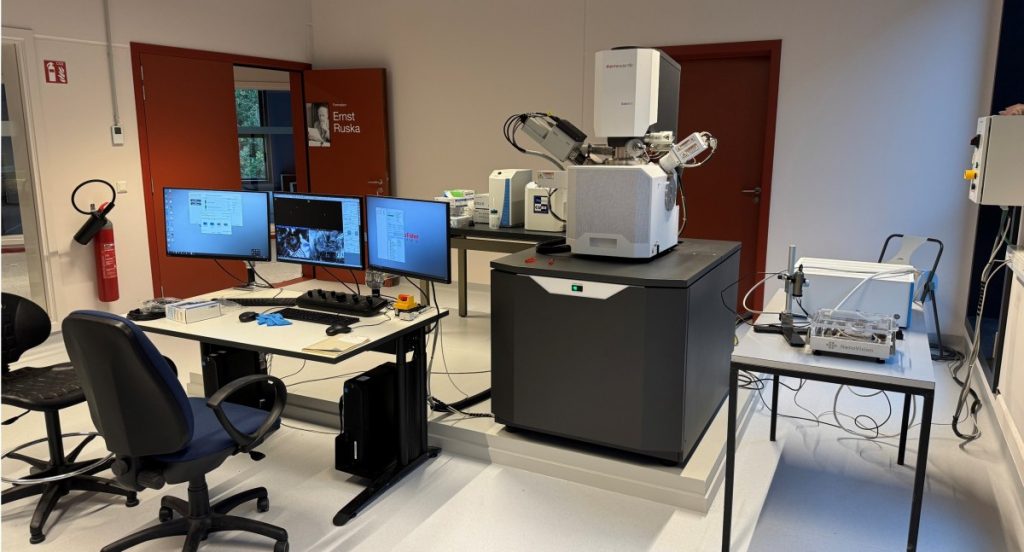
By coupling scanning probe microscopy with infrared and Raman spectroscopies, the laboratory can simultaneously investigate the chemical composition and nanoscale organization of materials through high-resolution chemical mapping. This capability is complemented by Scanning Electron Microscopy (SEM), providing a comprehensive suite of tools for exploring the nanoworld.
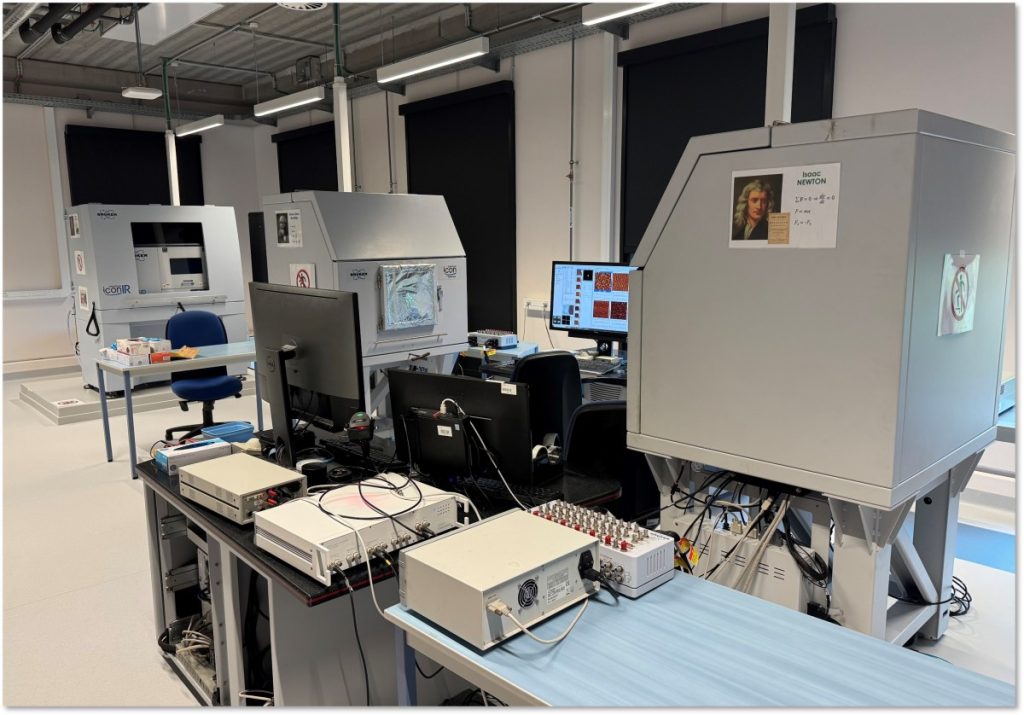
Such characterization is crucial for understanding how energy devices behave under thermal, mechanical, or electrical stress. Efficiency losses in photovoltaic cells, the gradual ageing of batteries, and the performance of piezoelectric materials capable of converting mechanical motion into electricity often originate from nanoscale processes occurring at interfaces between materials.
By identifying these mechanisms, LPNE researchers are able to propose new material architectures and device designs that improve both performance and long-term sustainability.
The laboratory investigates a broad range of functional materials, including conducting polymers, polymer nanocomposites, organic–inorganic hybrid materials, zinc oxide nanostructures, silver nanowires, and thin-film materials for organic electronics and next-generation photovoltaic technologies.
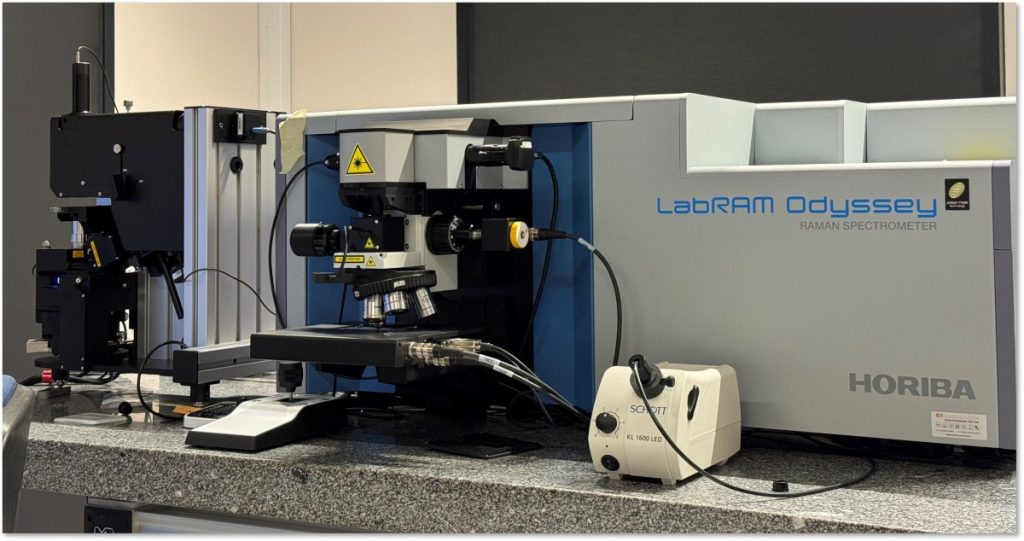
Nanomaterials for Energy Conversion, Harvesting and Storage
Fundamental science at the LPNE is closely connected to technological innovation. Researchers develop materials whose properties can be precisely engineered at the nanoscale to improve the efficiency of energy conversion and storage systems.
A major area of research focuses on zinc oxide (ZnO) nanowires and hybrid piezoelectric systems consisting of polymer matrices incorporating piezoelectric inorganic fillers. These materials exhibit outstanding piezoelectric properties: when subjected to pressure, vibration, or mechanical deformation, they generate electrical charges that can power autonomous sensors and ultra-low-power connected devices.
This work contributes directly to the development of energy harvesting technologies, which recover small amounts of energy from the surrounding environment instead of relying exclusively on conventional batteries.
The laboratory also develops hybrid materials and functional polymers for organic electronics and advanced photovoltaic devices. By investigating charge transport across material interfaces, researchers seek to reduce charge carrier losses, improve device stability, and extend operational lifetime.
These studies are equally relevant to electrochemical energy storage, where the performance of batteries and supercapacitors depends critically on interactions occurring at the interfaces between the different components of electrode materials.
A Collaborative Research Environment
Addressing these scientific challenges requires strong national and international partnerships. Beyond collaborations within the Research Institute for Materials Science and Engineering, the LPNE works closely with Materia Nova, the Belgian Ceramic Research Centre (BCRC), directly implied in MateriaLINKS, a recently created UMONS technological platform coordinated by Prof. Ph. Leclère. At the international level, LPNE is actively collaborating with several leading French universities, including Paris-Saclay, Toulon, Montpellier, Limoges, Orléans, and Le Mans, as well as the Conservatoire national des arts et métiers (CNAM) in Paris.
The laboratory also participates in research projects funded by the F.R.S.-FNRS, the Walloon Region, and the European Union. These collaborations provide access to world-class research infrastructures, promote interdisciplinary expertise, and facilitate technology transfer with industrial partners such as L’Oréal, the Belgian company Kersia, Michelin, and the global materials company SABIC.
International collaborations extend to the Federal University of Paraná (Brazil), Shibaura Institute of Technology and Science Tokyo (Japan), Tufts University and Oak Ridge National Laboratory in the United States.
The laboratory’s recent publications reflect the breadth of its research activities, covering nanoscale characterization of ferroelectric and piezoelectric materials, polymer nanocomposites, hybrid photovoltaic devices, and innovative approaches to solar energy storage. Beyond their immediate technological implications, these studies advance our understanding of the physicochemical mechanisms governing functional materials, laying the foundations for future industrial applications.
Towards High-Performance and Sustainable Materials
Despite significant progress, major challenges remain. Future energy materials must not only deliver higher performance but also offer greater durability, improved recyclability, and reduced reliance on critical raw materials, particularly metals. They must retain their functional properties over long operating lifetimes while remaining compatible with large-scale, cost-effective manufacturing.
In this context, combining nanomaterials physics with computational modelling and artificial intelligence is opening new opportunities to accelerate the discovery and optimization of materials for the energy transition.
As demand for low-carbon energy continues to grow worldwide, understanding and controlling matter at the nanoscale has become a strategic scientific priority. Through innovative approaches to materials characterization and engineering, the LPNE is contributing to the knowledge that will underpin the next generation of sustainable energy technologies.



Laboratory for Physics of Nanomaterials & Energy (LPNE)
UMONS
Bâtiment “Science des Matériaux” – BSM
19, avenue Victor Maistriau
B-7000 Mons
Tel.: +32 (0)65 37 38 68
Email: philippe.leclere@umons.ac.be
