
The University of Antwerp awards about 250 PhDs every year. It has almost 25,000 students, 18% of whom are from other countries. Together, its nine faculties offer 154 programmes, 35 of which are entirely English-spoken. Together, they also pool a wide range of fundamental and practice-oriented research.
“The University of Antwerp has 15 research excellence consortia (OEC), active in various scientific disciplines. They are international signposts that bring together consortia of outstanding researchers. Each OEC has a research manager who supports the consortium’s research strategy and plays a crucial role in identifying and raising funding opportunities,” says Maarten Weyn, vice rector research and impact.

Core facilities
“The core facilities are bundled per area of expertise, but for other equipment a distributed setting proved more appropriate. Although the core facilities are concentrated within certain strategic research groups, other researchers can also use their infrastructure. This fits in with our multidisciplinary approach. The next years, we will focus more than before on infrastructure. After all, this is an important criterion for attracting financing and is also beneficial for external partners. Internal needs will continue to be decisive in these investment decisions. But we will focus more on the coherence between the various investments and on long-term use. This includes immediately building in provisions for possible replacement and deploying this infrastructure for external users, so that this equipment can generate external income.”
Competitiveness
Internationally, UAntwerpen focuses on certain research areas. “For example, our EMAT team is a global leader in materials research and electron microscopy. Our expertise in infection and vaccination research within the Vaxinfectio group is also world-class. Consider, for instance, the brand-new vaccine research centre Vaccinopolis, a unique facility in continental Europe. In genetic and cancer research, environment and climate, sustainable chemistry, digital data and communication, social and political policy, we are also very strong. In the Times Higher Education World University Rankings we are now ranked 185. For a university of our scale and young history, that is a place we can be very satisfied with. Our international appeal is also reflected in our participation in various European Union-supported research projects by academic institutions and partners from different countries, and the increasing visibility and impact of UAntwerpen in society. Our investments in buildings and infrastructure where researchers and companies can think and work together such as BlueApp and The Beacon will further strengthen this in the future.”
From fundamental research to applications
In Flanders itself, research is further underpinned by collaborations with federal and regional institutes and agencies, and increasingly with industry. As far as applications are concerned, such collaborations are mainly via the Industrial Research Fund (IOF). This way, we do not stop at continuous fundamental research, but immediately create openings to practical applications.
“The research conducted at the University of Antwerp has a strong fundamental basis. In some fields, we are among the best in the world. However, it is equally important for us to translate scientific knowledge and insights into applications of social and economic importance. Today’s society has numerous challenges both at the level of ecology, health, sociology and economy,” says vice rector valorisation and development Steven Van Passel.
Strengthen the practice link
“In the past, the link between research and practice was too loose,” Weyn explains. “I want to strengthen that link. That is why my title of vice-rector research has been expanded to include research and impact. We will continue to support the existing centres of excellence, but at the same time we will also focus more on bottom-up free research, so that researchers have more space and variety to collaborate with internal and external partners. This will happen without any obligation to do so. In this way, they will continue to be among the top in fundamental research. Focusing purely on valorisation would detract from this, because then the aspect of knowledge acquisition could come to a standstill every time a practical result is achieved.”
Free research
“Financiers such as the Flemish government and the European Union often impose certain themes through their calls, but free research is an absolute condition for creating innovations,” explains Van Passel. “But a good balance between fundamental and applied is necessary to create more valorisation.”
“We are not only going to stimulate collaboration with external partners, but also strengthen that between our Centres of Research Excellence. They sometimes functioned too much as islands,” says Weyn. “That is why we are strongly investing the BOF resources in research projects and in research leaders who can bring several people with them, not with identical, but with complementary spheres of interest. We prefer to embed them in groups, so that they can adopt each other’s good practices. A broader composition of these groups stimulates the exchange of visions.”
New communication culture
“This approach also entails changes in internal communication. Our employees should not only be aware of the research of their colleagues in other disciplines, they should also be proud of it. This benefits the external impact of the entire university. One of the means to do this is to organize more events were people from different areas come together to exchange ideas, knowhow and experiences,” Weyn emphasizes.

Centres of Research Excellence (2026)
ACRAI
Antwerp Center on Responsible Artificial Intelligence
AIPRIL
Antwerp Interdisciplinary Platform for Research into Inequality
CASCH
CAtalysis for Sustainable organic CHemistry
EXPOSOME 2.0
Holistic approach to assess environmental exposures and their impact on endocrine and metabolic disorders
FAMFLEX
Flexible and complex families across the life-course
GCE
Global ecosystem functioning and interactions with global change
GOVTRUST
Trust in Governance of Societal Transitions
INteractions between CItizens and POLiticians
Infla-Med
Fundamental and translational research into targets for the treatment of inflammatory diseases
µNeuro
Alliance for multidimensional and multidisciplinary neuroscience
Nano-Light
Nanoparticles in the spotlight: light-driven nanoscience from lab to society
PLASMA
Plasma for environmental, medical, analytical chemistry and materials applications
TRANSGEN
From biomarkers towards personalized medicine
U-MaMi
Advancing health equity through microbiome-centric and multidisciplinary research
VAXINAID-C2P
Vaccination, infectious diseases, antimicrobials and immunotherapies: data science from cell to policy
Technology reveals tumour and brain metabolism
UAntwerp was one of the first research centres in Europe to introduce a new system based on advanced MRI technology. It will give scientists unique insights into the metabolism of diseased organs, helping them better understand how diseases develop and how patients respond to treatment.
Universities, research institutions and companies from seven countries are collaborating on the Q-AID project. Through its Digital Europe Programme, the European Union is investing 8.3 euro million in the consortium. The aim is to combine cutting-edge, high-performance MRI technology with artificial intelligence to visualise the metabolism of tumours and the brain. This could help advance the fight against cancer and neurological disorders.
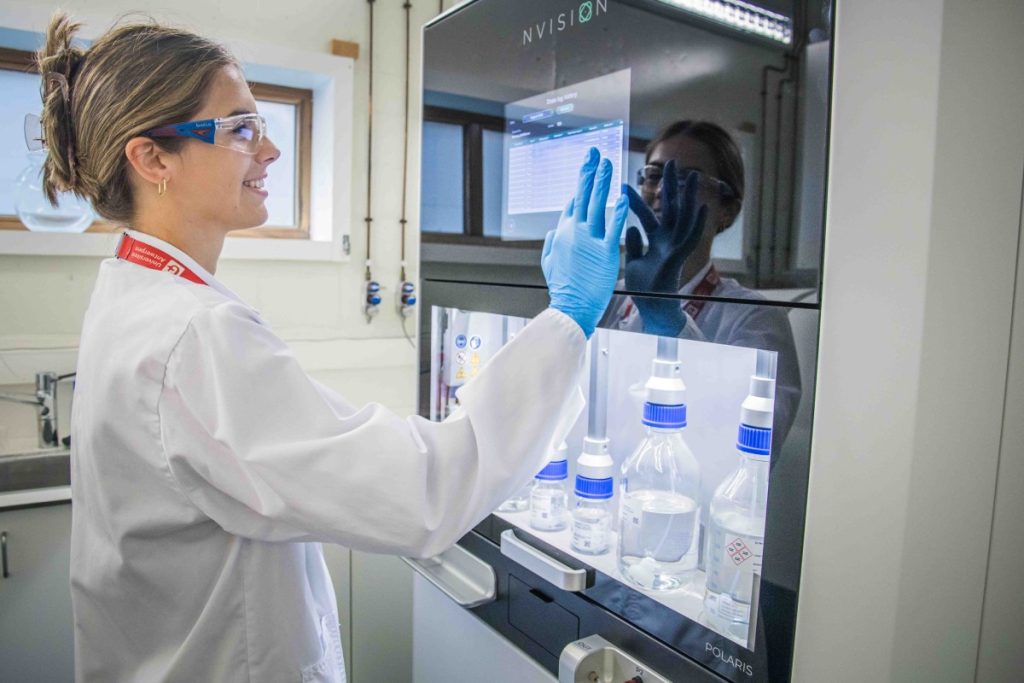
A key component of the project is the Polaris system, developed by German technology company NVision. The device temporarily makes ¹³C-labelled pyruvate (a molecule) much easier to detect by ‘hyperpolarising’ it, thereby enhancing its magnetic signal. After the hyperpolarised pyruvate has been injected, the MRI scanner can be used not only to examine tissue structure but also to track how the pyruvate is metabolised in the body, making metabolic processes visible.
Additional information layer
“Conventional MRI allows us to see very precisely where and when changes occur in the structure or function of the brain. Until now, however, we have been much less able to observe what happens at the metabolic level,” says Joëlle Van Rijswijk, researcher at UAntwerp’s Bio-Imaging Lab. “With this technique, known as hyperpolarised MRI, we can, for example, track how a substance such as pyruvate is converted into lactate. This gives us an extra layer of information about what is happening in diseased tissue.”
This opens up new possibilities for research into conditions such as glioblastoma. Tumours have a markedly abnormal metabolic activity . By mapping these processes, researchers hope not only to gain a better understanding of the disease but also to identify more quickly whether a treatment is having an effect. “In the longer term, this could help us monitor treatments more effectively and understand why a therapy works for one patient but not for another,” explains Professor Daniele Bertoglio.

Universiteit Antwerpen
Prinsstraat 13
2000 Antwerpen
Tel: + 32(0)3 265 41 11
