
Vrije Universiteit Brussel (VUB) gathers over 24,500 students from 150 countries across more than 150 programmes. With a staff of over 4,000, the university fulfils its mission of education and research. More than 70,000 alumni have made a difference worldwide as motivated entrepreneurs, critical researchers, and engaged citizens.
Among its academic staff of about 2,650, VUB also hosts more than 2,300 PhD students, of whom 54.4% are international. In 2025, they contributed to over 2,600 publications and 295 PhD defences, including 59 Joint PhDs.
Research budgets
“Our annual research budget amounts to 33.3 million euros,” states vice-rector of research Pieter Ballon. “Additionally, we receive 28.4 million euros from the Research Foundation Flanders for fundamental research and 14.1 million through private sector collaborations. Moreover, almost 80 million euros come from public project funding, including competitive grants from the European Union and the Brussels Region, often in partnership with the private sector.”
VUB ranks among the top 20 in terms of funding from the EU’s Horizon Europe programme. Between 2021 and 2025, its researchers secured 194 projects worth 119.7 million euros of which 37,2% from Pillar I (ERC, MSCA and Research Infrastructure). “VUB is the 4th Belgian organisation in the number of Horizon Europe projects and the 1st in euro’s secured per professor. Considering the total number of students and full-time professors, we were ranked first last year,” Ballon adds. In 2025, VUB secured 5 European Research Council grants and 13 Marie-Sklodowska-Curie Actions. The number of awarded ERC and MSCA projects has doubled in the past four years compared to the previous period.


Patents
VUB research has resulted in numerous patents. “Currently, we manage 228 active patent families, including 71 solely under VUB and the rest with partners like Imec and VIB,” says Ballon. “In 2023 alone, we filed 29 new patent applications. Our research has also led to over currently active 52 spin-offs.”
A specialized team focuses on valorisation, scale-up of research results, and intellectual property protection. Scale-up activities are primarily based in the research park in Zellik, near Brussels Airport. “We collaborate with external partners, ensuring spin-offs become independent while maintaining a limited number of shares.”
Internationalisation
VUB is part of Eutopia, a European university alliance that fosters inter-institutional partnerships beyond geographical and traditional academic boundaries. “Eutopia currently includes 10 universities coordinating research policies. Like VUB, they are relatively young institutions, making them agile in multilingual offerings and in attracting international lecturers and students,” explains Ballon. Being a young university allows VUB to pioneer multidisciplinary research. “For instance, we lead in the chemical dating of archaeological material,” he notes.
Key themes
VUB prioritizes several research themes. “Artificial intelligence is a key focus. In 1983, we were the first European university to establish an AI lab,” Ballon states. Other major areas include decarbonisation, energy, sustainability, and electric mobility, with nearly 300 researchers dedicated to these fields. Future focus areas include IT, robotics, and life sciences, particularly biomedical applications.
Teaching soft robots to sense, repair and adapt
Soft robots that provide patients with tailored support during rehabilitation, gain a sense of touch to handle delicate objects safely, and switch between soft and rigid states depending on the task are among the ambitions of RESSORT, a European research project led by VUB. Funded by the EU’s Horizon Europe programme, the four-year project brings together 14 partners from Belgium, Denmark, Germany, Greece, Norway, Sweden and Switzerland to make soft robots more sustainable, intelligent and reliable, with applications in healthcare, the food industry and industrial inspection.
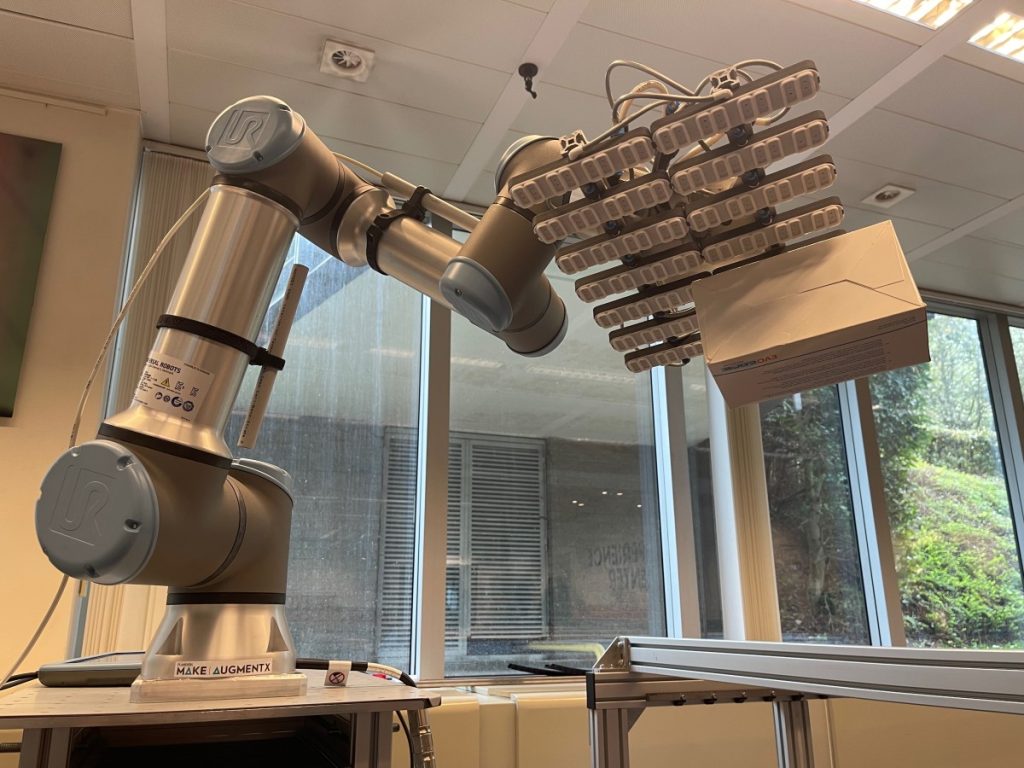
Unlike conventional robots, soft robots are made from flexible materials, allowing them to adapt to their surroundings and interact more safely with people and delicate objects. Their wider use is still limited, however, by challenges involving durability, sensing, manufacturing and reliability.
Led by Professor Bram Vanderborght, RESSORT (Resilient Efficient Soft and Sustainable Optimized Robotics Technology) aims to address these challenges by combining several technologies. These include self-healing materials, variable-stiffness structures that can switch between soft and rigid states, affordable 3D tactile sensors, artificial intelligence that adapts to changing environments, and advanced multi-material 3D printing.
To test the technologies under realistic conditions, RESSORT will develop three demonstrators. In healthcare, researchers will create a personalised soft exosuit, a wearable device providing comfortable and safe support during rehabilitation or everyday movement. For the food industry, they will develop an adaptive robotic system for handling fragile products of different shapes and sizes. The third demonstrator is a deformable drone for inspection in confined or vulnerable environments. It will be able to deform to navigate narrow passages and become more rigid when required.
Barringer Medal for meteorite impact research
VUB geologist and planetary scientist Philippe Claeys has been awarded the Barringer Medal for a research career spanning more than three decades and focusing on meteorites, impacts and major changes in Earth’s history.
Claeys became fascinated by the meteorite impact at the Cretaceous-Palaeogene boundary while still a PhD student. He obtained his PhD from the University of California in 1993, with Walter Alvarez among his supervisors. Alvarez had discovered crucial geological evidence linking a massive meteorite impact 66 million years ago to the mass extinction of, among others, the non-avian dinosaurs.

Claeys built on that research, making major contributions to our understanding of the Chicxulub crater in Mexico and the geological and ecological consequences of the impact. He studied rock layers around the world containing material ejected during the impact and took part in scientific drilling campaigns in the Chicxulub crater. He also worked at other major impact sites. His research examines how major changes in the Earth system throughout geological history can be reconstructed.
Core facilities and infrastructure platforms
VUB research infrastructure is organized into 11 core facilities and infrastructure platforms:
- BRIGHTcore: in this interuniversity platform, servicing both ULB and VUB universities and their university hospitals, Hôpital Erasme & Hôpital Huderf and UZ Brussel, heavy – expensive – genomics equipment is centralized and IT infrastructure is made available for primary analyses of large genomic datasets.
- Brubotics Rehabilitation Research Centre (BRRC): Interdisciplinary human movement analysis lab specializing in robotic and technology-supported rehabilitation research.
- In Vivo Cellular and Molecular Imaging (ICMI): Core facility for nuclear and optical imaging of small animals, equipped with multi-modality cameras and ex vivo analysis techniques.
- Flow Cytometry (FlowCore): Offers advanced instruments for analysing and sorting biological materials.
- Materials Characterisation: Provides analytical tools for material characterization.
- Microlab: A 300 m² cleanroom dedicated to microfabrication of glass and silicon for microfluidics, supporting both research and industry.
- Square: Provides complementary statistical and methodological support to researchers and research groups.
- Animalarium: Manages the housing and care of research animals.
- VSTA: Specializes in DNA aberration detection, multiplex RNA and protein expression analysis, and whole-slide imaging.
- Belgian Online Probability Panel (BOPP): A national data infrastructure supporting interdisciplinary research in behavioural and social sciences.
- Brussels Digital Text Lab (B-TXT): Supports digital text analysis, data collection, and archiving for researchers in social sciences and humanities.
- Humanise (HUMan and ArtIficial miNdS and bodIEs): Provides expertise, experimental rooms, and equipment for research on the human mind and body.
- 7TeslaMRI: with this 42-ton weighing scanner, researchers can better understand diseases such as dementia, epilepsy, cartilage degeneration, kidney disorders, and tumours, and refine their treatment.

Vrije Universiteit Brussel (VUB)
Pleinlaan 2 – B-1050 Brussel – Tel.: +32 2 629 20 10
Email: info@vub.be – https://www.vub.be/en
