
Researchers from KU Leuven (Belgium), Chalmers University of Technology (Sweden), University of Gothenburg (Sweden), and University of Huelva (Spain) have developed an innovative concept to enhance the application of multiphoton microscopy. The implementation of this ‘4for2’ concept is expected to pave the way for improved tools in the clinical diagnosis and monitoring of diseases.
Multiphoton microscopy is a widely used technique for visualizing cells and studying their behavior. It relies on small dye molecules that simultaneously absorb multiple photons and subsequently emit light —a process known as fluorescence. Once internalized in cells, these dyes act as reporters, providing information about their location and environment through detectable fluorescence signals.
Beyond Standard Techniques
“The spatial resolution—how precisely we can localize structures—improves significantly when multiple photons are absorbed by the dye. In standard systems, two-photon absorption is commonly used, but four-photon absorption would yield much higher resolution. Unfortunately, achieving four-photon absorption is extremely challenging: it requires extremely powerful lasers and the longer wavelengths typically employed can in turn compromise resolution,” explains Professor Johan Hofkens, head of the Laboratory for Photochemistry and Spectroscopy at KU Leuven.
“The 4for2 concept provides an elegant solution to this limitation, an important step toward achieving better resolution. It leverages well-established two-photon absorption processes but produces fluorescence as if four photons had been absorbed. This will allow for much clearer and higher-definition imaging of, for example, cellular structures.”
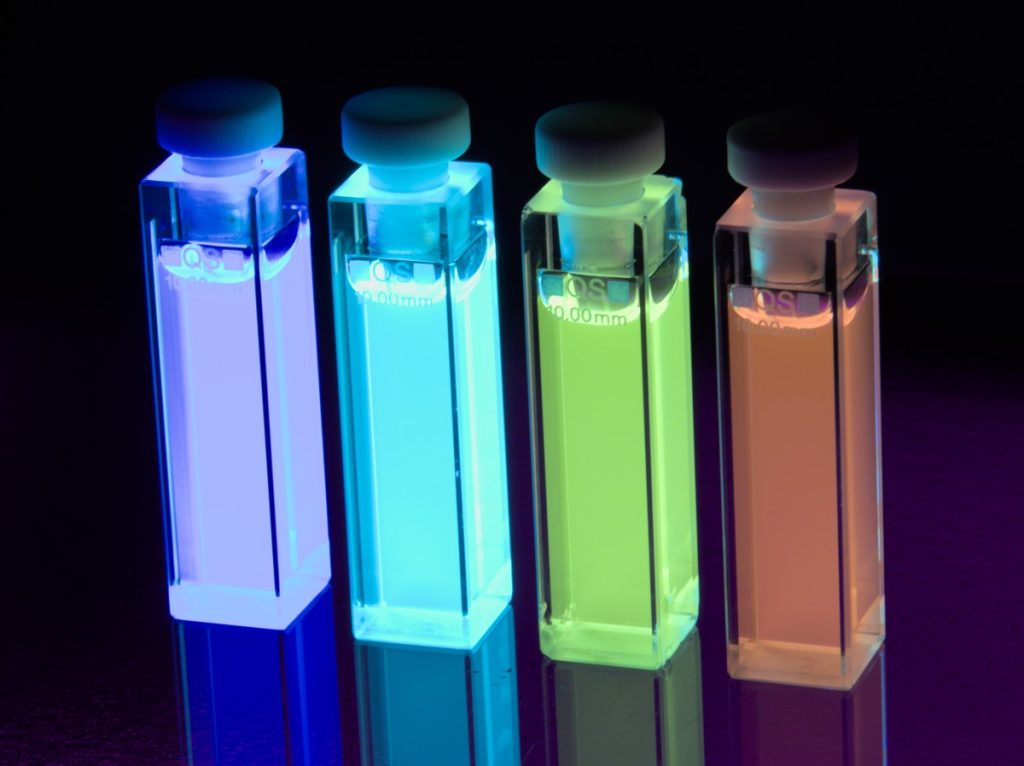
To accomplish this, the Belgian, Swedish, and Spanish researchers combined two distinct two-photon processes—effectively a 2 × 2 = 4 approach. This innovative strategy represents a paradigm shift and was successfully demonstrated in a publication in the prestigious journal Nature Communications.
European Approach
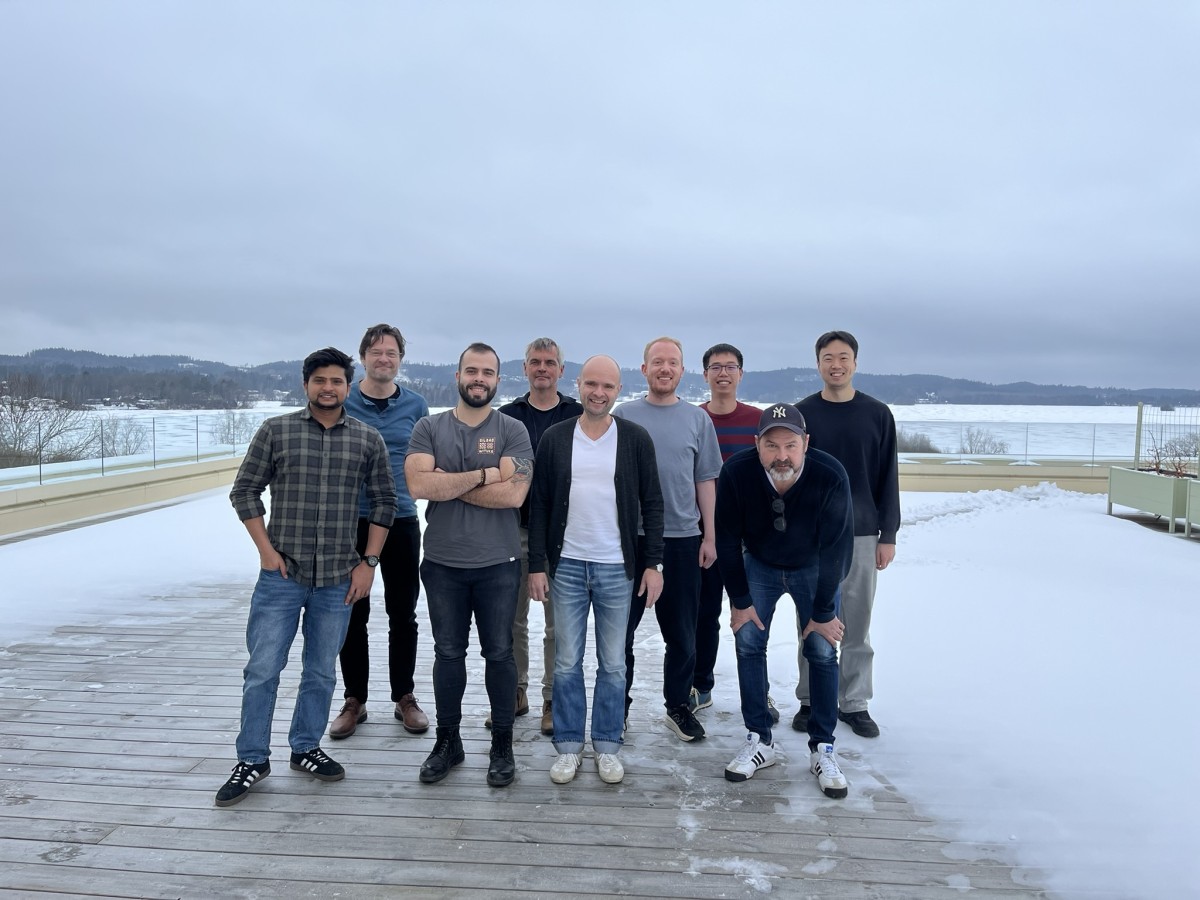
The 4for2 project was funded in the framework Horizon Europe’s highly competitive Pathfinder Open call. The research spanned three years and was completed at the end of February 2026. Over the three-year duration of the project, around fifteen researchers were active across the different locations at any given time, from job students to doctoral students, technical staff and postdoctoral researchers.”
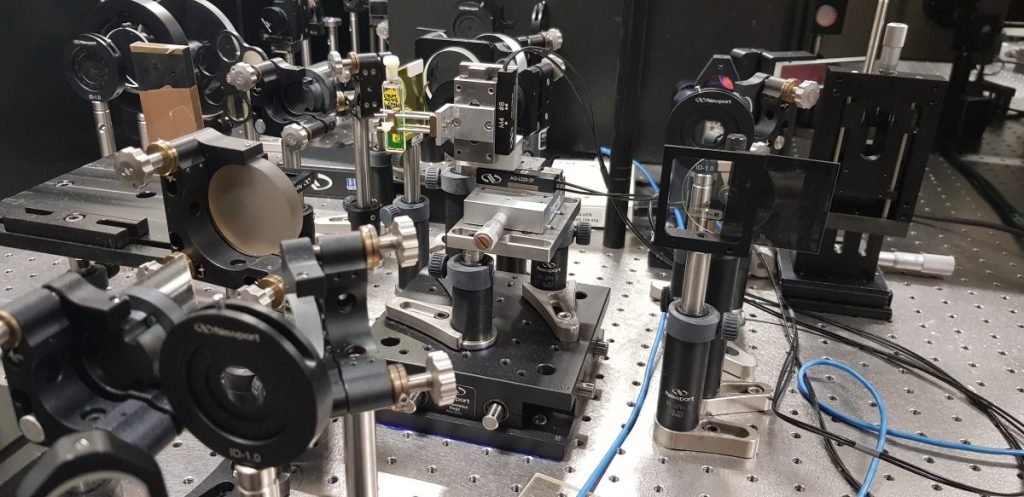
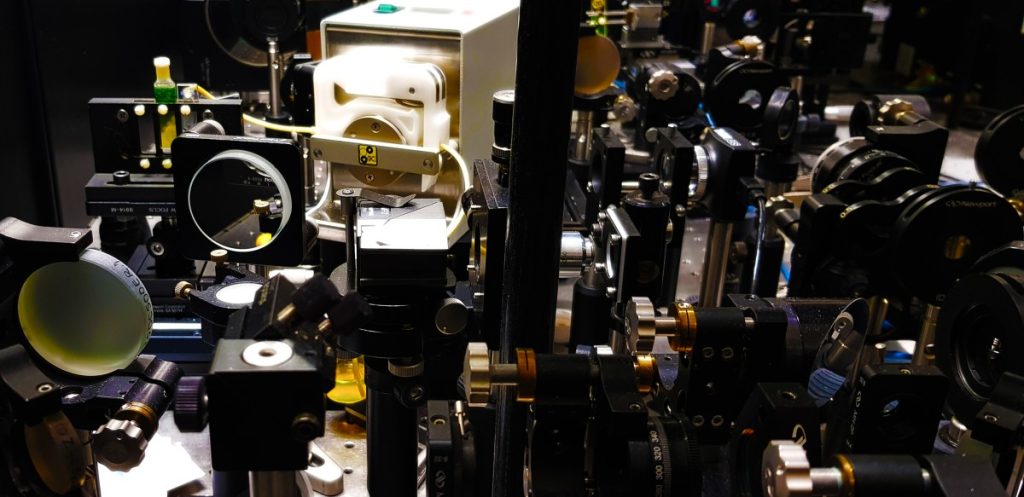
“Our colleagues in Sweden and Spain developed a range of dye molecules that consist of a two photon probe linked to a photoswitch,” explains Dr. Flip de Jong, project leader in Leuven. “In Leuven, we carried out the advanced spectroscopic investigations. The goal was to make sure that the first arriving two photons do indeed ‘switch the probe on’ so that the arrival of the second pair of photons leads to fluorescence.”
Exciting results
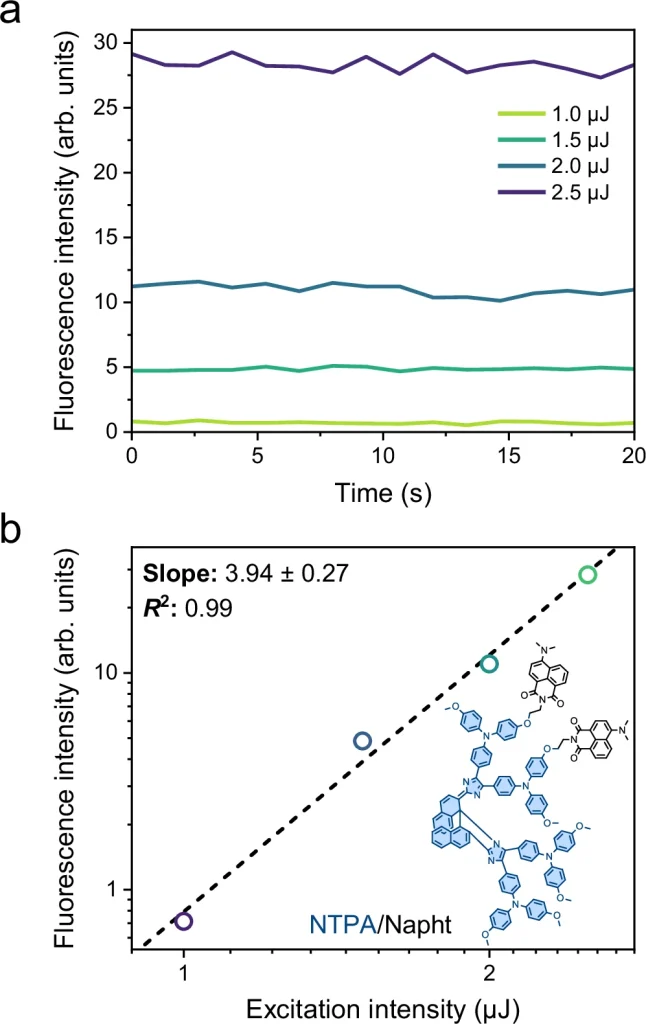
“We have clearly demonstrated that the interplay between the underlying photophysical and photochemical processes produces a potentiated nonlinear fluorescence response, which forms the basis for enhanced resolution,” says project coordinator Professor Joakim Andréasson of Chalmers University of Technology. “We are confident this will serve as a foundation for continued collaboration within the consortium.”
“The entanglement of multiple two-photon processes is truly a game changer,” adds Professor Hofkens. “It enables scientists to push the boundaries of multiphoton microscopy and imaging. The proof-of-concept delivered in this Pathfinder Open project is an important first step toward a powerful tool with broad implications for life sciences and healthcare.”
Cost-Effective, Superior Resolution
“Our goal is to enable users of two-photon microscopy to benefit from the superior resolution typically associated with four-photon microscopy, while tailoring solutions to researchers for their needs,” Hofkens explains.
The developed probes combine the advantages of two-photon microscopy—such as lower excitation energies, standard lasers around 800 nm, and optimal tissue penetration—with the high spatial resolution of four-photon microscopy, reaching 150 nm or less.
“This represents a substantial improvement over one- or two-photon excitation schemes using similar hardware, marking a genuine paradigm shift in multiphoton microscopy. Importantly, the technology should allow researchers to achieve four-photon-like resolution while remaining compatible with existing two-photon equipment. As a result, upgrades can be implemented in a cost-effective manner without requiring significantly more expensive 1600 nm laser systems.”
Practical Applications
Professor Andréasson has already patented the developed technique in the United States, with patent applications currently underway in Europe, China, Japan, and Australia. In Sweden, the 4for2 research has led to the creation of a spin-off company, Galanto Labs.
“We primarily expect practical applications in biology, and subsequently in the broader life sciences,” says De Jong. “Our concept will provide a significant improvement in imaging quality without needing new hardware.”
Water-soluble Dyes
Follow-up research is focusing on water-soluble dyes and functionalising the 4for2 dyes to improve their interaction with different targets. These developments could expand the range of applications, for instance by enabling targeting of specific locations within a cell.
“Because we place strong emphasis on the practical applicability of our academic research, we regularly consult with an end-user group,” De Jong concludes. “These specialists are recruited through networks and associations of microscopy researchers, allowing us to stay closely aligned with real-world needs.”

Funded by the European Union under the Horizon Europe grant 101098934 (4for2). Views and opinions expressed are however those of the author(s) only and do not necessarily reflect those of the European Union or the European Innovation Council and SMEs Executive Agency. Neither the European Union nor the granting authority can be held responsible for them.





Andréasson Lab
Chalmers University of Technology
Department of Chemistry and Chemical Engineering, Division of Chemistry and Biochemistry
Kemivägen 10
41296 Gothenburg, Sweden
Tel: +46 (0)31 772 28 38
Email: a-son@chalmers.se
Web: Andreassons-research-group
Hofkens Lab – KU Leuven
Celestijnenlaan 200F – bus 2404
Chem & Tech Building – B-3001 Heverlee
Tel.: +32 (0)16 32 78 04
Email: johan.hofkens@kuleuven.be
